The 6 Franchise Coaching Styles: Why Your Field Coaches Need More Than One

Quick answer: The six franchise coaching styles AC Inc teaches are Directive, Facilitative, Transformative, Structured, Psychological, and Holistic. Most field coaches naturally rely on one or two. The most effective coaches identify their own default style first, then read each franchisee’s DISC personality and adapt their delivery, while the coaching framework and accountability stay the same.
Key takeaways
- Every coach has a natural coaching style. The problem isn’t having one. It’s letting it become your only one.
- Coaches need to know themselves, their own style and DISC, before they can read the franchise owner in front of them.
- Directive, Facilitative, and Transformative pair naturally with high-energy D and I personalities. Structured, Psychological, and Holistic are the stretch styles most coaches need to develop for Steady and Compliant owners.
- Adapting your style doesn’t change the plan. Same plan. Same accountability. Different delivery.
In this article
- Are your coaches giving every franchisee the same conversation?
- What are the six franchise coaching styles?
- Step 1: Know yourself
- Step 2: Know the owner
- Where they meet: same plan, different delivery
- What this means for franchise leaders
- Frequently asked questions
Are your coaches giving every franchisee the same conversation?
Does your coaching actually change from person to person, or does every franchisee get a version of the same conversation?
Most field coaches aren’t intentionally using one rigid approach. They’re simply relying on the style that feels most natural to them, especially when the conversation gets difficult.
But comfortable isn’t always effective.
A coach who naturally likes to give direct answers may keep telling franchisees what to do. A coach who prefers asking thoughtful questions may keep facilitating when the situation calls for clearer direction. Either way, some franchisees get exactly what they need, and others quietly check out.
For franchise leaders, this shows up as symptoms that are easy to misread. Franchisees disengage from their support team. Tenured owners push back because they know their business and their market, and they don’t want to be told what to do. Franchisees become dependent on their coach for every answer, and coaches burn out trying to be the solution to everything.
Those aren’t franchisee problems. They’re usually a sign that your coaches have one or two styles and have never been taught how to build range.
What are the six franchise coaching styles?
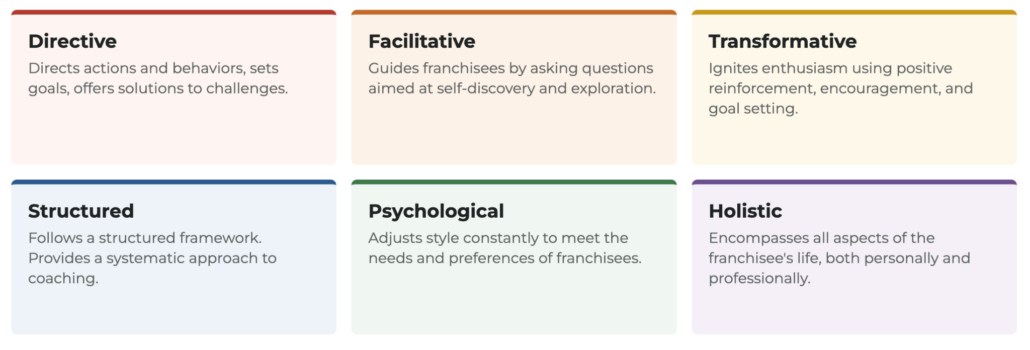
AC Inc teaches six coaching styles. Each one is a different way of moving a franchisee toward action.
1. Directive coaching
Directive coaching means the coach directs actions and behaviors, sets goals, and offers solutions to challenges. It’s the style many coaches default to because providing a solution feels credible and valuable.
Directive coaching has a place. There are moments when a franchisee needs clear direction. The risk is when telling becomes the whole call. When franchisees are handed answers instead of working through problems, they don’t build the skills to solve the next one on their own.
2. Facilitative coaching
Facilitative coaching means the coach guides franchisees by asking questions aimed at self-discovery and exploration. Instead of handing over the answer, the coach helps the franchisee figure out what they need to do, how to do it, and what they actually want to do.
This matters because when an idea is the franchisee’s own, they’re far more likely to buy in and follow through. The risk on the other side: a coach who only facilitates may keep asking questions when the moment calls for clearer direction.
3. Transformative coaching
Transformative coaching means the coach ignites enthusiasm using positive reinforcement, encouragement, and goal setting. It’s the style that helps franchisees see progress, feel capable, and stay motivated toward a goal they care about.
4. Structured coaching
Structured coaching means the coach follows a structured framework and provides a systematic approach to coaching. Think consistent call agendas, reviewing last session’s action steps, and tracking commitments somewhere both the coach and franchisee can see them.
5. Psychological coaching
Psychological coaching means the coach explores the internal beliefs, emotions, assumptions, and patterns that may be influencing behavior. They listen for the “story under the story” and help the franchisee understand why they may continue to stall, avoid, or react in certain ways.
This style combines curiosity, empathy, reflection, and thoughtful challenge. The goal is to turn deeper self-awareness into a practical change in behavior or decision-making.
Coaching is not therapy. Coaches should maintain clear boundaries and avoid deep psychological probing beyond their training. If clinical mental health concerns or trauma surface, the franchisee should be referred to an appropriately qualified professional.
6. Holistic coaching
Holistic coaching encompasses all aspects of the franchisee’s life, both personally and professionally. A franchisee’s business goals rarely exist on their own. They’re often tied to something personal, like more time with family, and a holistic coach connects the two.
Step 1: Know yourself
Before coaches can effectively adapt to anyone else, they need to understand themselves.
That’s why AC Inc teaches “Know Yourself” before “Know the Owner.” You can’t intentionally flex a default you haven’t identified.
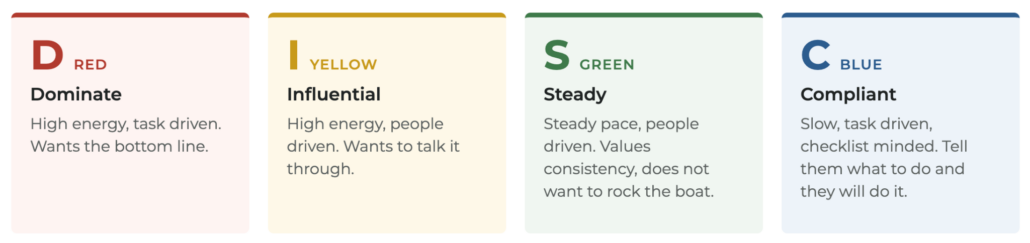
DISC is the starting point. It helps coaches recognize their natural communication tendencies, decision-making style, and how they typically respond under pressure. Coaching styles build on that by helping coaches understand how they naturally lead, influence, challenge, and move people toward action.
The four DISC personality types
Which coaching styles come naturally?
The first three coaching styles, Directive, Facilitative, and Transformative, pair naturally with the high energy of D and I personalities. Many coaches find these styles comfortable because they match how they already like to communicate.
Structured, Psychological, and Holistic are the stretch styles. These are the styles most coaches need to intentionally develop, because they’re what Steady and Compliant owners often need to feel supported.
Most coaches naturally rely on one or two styles. The best coaches recognize those tendencies and intentionally expand their range instead of defaulting to what feels most comfortable.
Step 2: Know the owner
Every franchisee communicates differently, processes information differently, and responds to coaching differently.
Some want to brainstorm before making a decision. Others want the bottom line. Some need reassurance before taking action, while others are looking for clear expectations and accountability.
Once a coach knows their own default, reading the franchisee’s DISC type helps them see where the gap is. A high-energy coach working with a Steady or Compliant owner is exactly the situation where the stretch styles matter most.
Understanding those differences doesn’t change your coaching process. It helps you deliver it in a way the franchisee can actually receive.
Where they meet: same plan, different delivery
Once a coach understands both themselves and the franchisee they’re working with, they can adapt their delivery without changing the coaching process.
Good coaching isn’t simply matching personalities. It’s helping franchisees develop the skills their business requires.
The framework stays consistent. The delivery becomes intentional.
Same plan. Same accountability. Different delivery.
That doesn’t mean becoming six different coaches. It means knowing when to ask more questions, when to provide clearer direction, when to challenge someone’s thinking, when to bring more structure and accountability to the conversation, and when to explore the deeper beliefs or patterns that may be keeping a franchisee stuck.
The goal isn’t to use every style in every conversation. It’s to build enough range to use the right style, at the right time, for the right reason. This reflects the coaching handout’s definition of building range.
What this means for franchise leaders
If you lead a field support or operations team, the question isn’t whether your coaches are working hard. It’s whether they have the range to reach every franchisee in your system.
Signs your coaching team may be relying on one style:
- Franchisees are disengaging from their support team, especially tenured owners.
- Franchisees rely on their coach for answers instead of solving problems themselves.
- Coaches are stretched thin and burning out.
- Coaching looks a lot like operational training and support.
- Calls end with a list of what the coach wants done rather than steps the franchisee agreed to.
Most coaches were never taught another way. When operations is what they know, it becomes the default. That’s why AC Inc’s Strategic Growth Coaching framework is built around goals, proactive coaching, and action steps the franchisee owns.
Try this with your team this week
Start with one simple challenge: talk less, ask more questions.
Ask your coaches to try it on one franchisee call this week, then compare how the franchisee responded.
Encourage them to pay attention to whether they are defaulting to the style that feels most natural or intentionally choosing the approach the franchisee and situation need.
Build a coaching team with range
Your franchisees aren’t the problem. When coaches know their own default, understand each owner, and have the range to adapt, franchisees stay engaged, follow through, and grow.
Want to see where your coaching team’s range stands today? [Book a call with AC Inc]
For coaches ready to develop these skills, Field Coach Certification – ACcelerator Program builds the communication, coaching, and emotional intelligence skills that help franchisees feel understood, challenged, and supported.
Learn more about Field Coach Certification – ACcelerator Program
Frequently asked questions
What are the six coaching styles in franchise coaching?
The six coaching styles AC Inc teaches are Directive, Facilitative, Transformative, Structured, Psychological, and Holistic. Directive coaches set goals and offer solutions. Facilitative coaches ask questions that lead to self-discovery. Transformative coaches use encouragement and goal setting. Structured coaches follow a systematic framework. Psychological coaches explore internal beliefs, emotions, assumptions, and patterns that may be influencing behavior. Holistic coaches consider the franchisee’s personal and professional life.
What’s the difference between directive and facilitative coaching?
Directive coaching means the coach directs actions, sets goals, and offers solutions. Facilitative coaching means the coach asks questions that help the franchisee discover their own answers. Directive coaching is faster in the moment, but facilitative coaching builds buy-in, because franchisees are more likely to follow through on a plan they came up with themselves.
Is directive coaching bad?
No. Directive coaching has a place, and there are moments when a franchisee needs clear direction. The problem is when it becomes a coach’s only style. Coaching that’s all telling can create franchisee dependency, disengagement, and coach burnout.
How does DISC relate to coaching styles?
DISC helps coaches understand their own natural communication tendencies and those of each franchisee. The four DISC types are Dominant, Influencer, Steady, and Compliant. Coaching styles build on DISC by showing how a coach naturally leads and moves people toward action, and which styles they need to develop.
Why should coaches “know yourself” before “know the owner”?
You can’t intentionally flex a default you haven’t identified. When coaches first understand their own DISC type and natural coaching style, they can recognize when that style isn’t working for a franchisee and adapt their delivery on purpose.
Which coaching styles work best for Steady and Compliant franchisees?
Directive, Facilitative, and Transformative pair naturally with high-energy D and I personalities. Structured, Psychological, and Holistic are the stretch styles most coaches need to develop to connect with Steady and Compliant owners.
What is psychological coaching?
Psychological coaching explores the internal beliefs, emotions, assumptions, and patterns that may be influencing a franchisee’s behavior. The coach uses curiosity, empathy, reflection, and thoughtful challenge to help the franchisee turn deeper self-awareness into practical changes in behavior or decision-making. Coaching is not therapy, and coaches should maintain clear professional boundaries.
What is the 70/30 rule in coaching?
The 70/30 rule means the franchisee should be doing most of the talking on a coaching call, roughly 70 percent, while the coach speaks about 30 percent. A coach who talks more than the franchisee is usually telling instead of coaching.
Does adapting coaching style mean changing the coaching process?
No. The coaching framework, plan, and accountability stay consistent. What changes is the delivery: tone, pace, the questions a coach asks, and how much structure or direction they provide.
Same plan. Same accountability. Different delivery.
That doesn’t mean becoming six different coaches. It means knowing when to ask more questions, when to provide clearer direction, when to challenge someone’s thinking, and when to bring more structure and accountability to the conversation.